

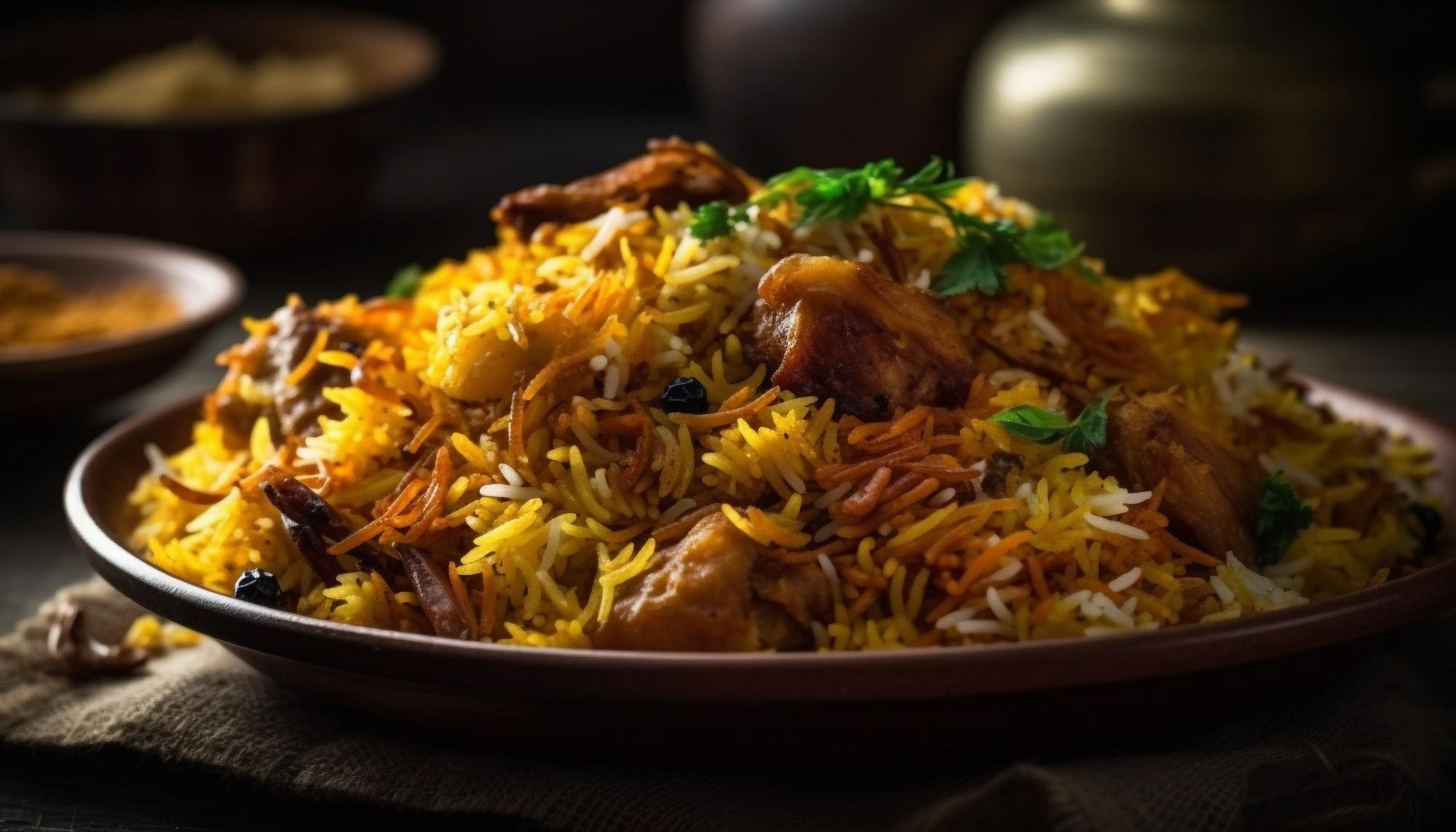
Machboos and the Story Behind the UAE’s National Dish
On any given Friday in the UAE, somewhere between the call to midday prayer and the slow unwinding of a family afternoon, a large platter of golden rice makes its way to the center of the table. The meat sits on top, fall-apart tender, surrounded by fried onions, raisins, and a scattering of toasted nuts. Steam carries the scent of cardamom and cinnamon, along with something tangier and harder to place at first. That dish is Machboos, and for most Emirati families, it needs no introduction. For everyone else, the question is worth asking properly: how did a spiced rice dish become so closely tied to national identity that it is routinely described as the Machboos UAE national dish?
The answer sits at the crossroads of geography, trade, and hospitality. Machboos did not appear in isolation. It was shaped by centuries of dhow trade across the Arabian Gulf, by the resourcefulness of Bedouin desert cooking, and by the UAE’s long-standing position as a meeting point between the Arabian Peninsula, Persia, and the Indian subcontinent. Understanding Machboos means understanding a good portion of Emirati history itself, told through rice, spice, and the simple act of sharing a meal.
What follows is a closer look at how that history actually unfolded: where the dish’s defining ingredients came from, why it occupies such a central place at Emirati celebrations, how it differs from the rice dishes it is most often confused with, and where it can still be experienced in something close to its original form today.
What Is Machboos? A Quick Introduction to the Dish
At its simplest, Machboos is a one-pot rice dish built around three components: long-grain rice, a protein, most commonly chicken, lamb, or fish, and a spice blend that gives the dish its distinctive character. The protein is browned and slow-cooked in a broth seasoned with the Emirati spice mix known as bezar, along with dried black lime, before the rice is added to absorb the resulting stock. The result is neither as dry as a pilaf nor as wet as a stew, but something in between: each grain of rice carrying the flavor of the broth it was cooked in, rather than sitting on top of it.
Key Ingredients That Define Machboos
- Long-grain basmati rice, prized for its ability to absorb flavor without turning sticky.
- A protein base of chicken, lamb, fish, or occasionally shrimp.
- Loomi, the dried black lime that gives the dish its tangy, slightly smoky undertone.
- Bezar, the Emirati spice blend typically built from cumin, coriander, turmeric, cinnamon, and black pepper.
- A tomato and onion base that forms the foundation of the cooking broth.
- Ghee, used for browning the meat and adding richness to the finished rice.
Each Emirati household tends to have its own version of bezar, with proportions passed down rather than measured precisely, which is part of why no two plates of Machboos taste quite the same even when the ingredient list looks identical on paper.
The Historical Origins of Machboos
Machboos belongs to a family of rice dishes found across the Gulf, and its roots trace back further than the UAE itself as a nation. Long before borders were drawn between the Emirates, Bahrain, Qatar, Saudi Arabia, Kuwait, and Oman, the communities along the Arabian Gulf coastline were connected less by land than by sea, and their kitchens reflected that reality long before anyone thought to write the recipes down.
The Role of Maritime Trade in Shaping Emirati Food
For generations, the economy of the coastal Gulf revolved around pearling, fishing, and dhow trading. Sailors and merchants moved constantly between the Arabian coast, the Persian shoreline, and ports across the Indian Ocean, carrying goods in both directions. Rice, an ingredient that does not grow naturally in the desert climate of the Emirates, arrived through exactly this kind of trade, alongside spices such as cardamom, cinnamon, and black pepper that had originally travelled from India and beyond.
This same pattern of maritime exchange, repeated over centuries, later became one of the underlying forces behind the UAE’s emergence as one of the world’s most diverse food destinations, long after oil transformed the country’s economy and its skyline. Dried limes, the defining sour note in Machboos, are believed to have entered the region’s cooking through trade with Oman and Persia, where the technique of boiling and sun-drying limes for preservation had already been established. Over time, ingredients that started out as imports stopped being treated as foreign additions and simply became part of what is now considered authentically Emirati.
Bedouin Cooking and the Desert Side of the Story
The coastal trade routes explain where many of Machboos’ ingredients came from, but the cooking method owes just as much to the desert interior. Bedouin communities, moving between grazing grounds with limited fuel and water, developed a strong preference for one-pot cooking: a single vessel, slow heat, and ingredients added in stages rather than prepared separately. That same logic runs through Machboos today. The meat, the broth, and the rice are cooked in sequence within one pot, a method that wastes nothing and requires no specialized equipment, a practical necessity that eventually became a defining culinary style in its own right.
Shared Roots Across the Gulf
Because this trade network connected the entire Gulf coastline rather than any single country, versions of Machboos exist well beyond the UAE. Saudi Arabia has its kabsa, Bahrain and Qatar have their own machboos traditions, and Kuwait’s machboor follows a similar logic. What distinguishes the Emirati version is less the basic technique than the specific balance of spice: a slightly lighter hand with chili, a more pronounced use of loomi, and a bezar blend that leans toward warmth rather than heat. These are subtle distinctions, but they are the kind that Emirati cooks and regular diners notice immediately, even when visitors might not.
Why Machboos Is Considered the National Dish of the UAE?
Plenty of dishes are popular without ever being described as a national dish. What sets Machboos apart is the role it plays at moments that matter. Weddings, Eid al-Fitr and Eid al-Adha celebrations, Ramadan iftars, and UAE National Day gatherings all tend to feature Machboos somewhere on the table, often as the centerpiece rather than a side. A dish earns that kind of status only when it becomes tied to memory and occasion rather than simple everyday availability, and Machboos has held that position for long enough that few people in the UAE can remember a time when it did not.
Machboos at Eid, Ramadan, and National Celebrations
The connection between Machboos and celebration is not vague or sentimental; it shows up consistently around specific dates on the calendar. During Eid al-Fitr, when families gather after a month of fasting, Machboos is frequently the dish served once the morning prayers and visits are done, often prepared in large enough quantities to feed extended family and visiting neighbors. Eid al-Adha follows a similar pattern, typically built around lamb given the occasion’s association with sacrifice. Wedding feasts lean toward the same dish at a larger scale, sometimes prepared in enormous batches to serve hundreds of guests over a single evening. Even the UAE’s National Day on December 2nd, a date built around modern nationhood rather than religious observance, tends to bring Machboos back to the table, which says something about how thoroughly the dish has become attached to the idea of celebration itself, regardless of the specific reason behind it.
Machboos as a Symbol of Emirati Hospitality
Hospitality occupies a particular place in Emirati culture, and food is one of its clearest expressions. Traditional meals are often served on a single large platter set in the middle of the table, with everyone eating from the same dish rather than individual plates. This style of communal dining, rooted in older Bedouin and majlis traditions, turns a meal into a shared experience rather than an individual one. Machboos, with its size and presentation, suits this style of eating particularly well. Offering a guest a generous portion from the same platter is itself a gesture of welcome, a tradition that predates the UAE’s modern hospitality industry by a long way, even as that industry now builds much of its identity around the very same values.
How It Reflects the UAE’s Multicultural Heritage?
Machboos is also a useful lens for understanding how the UAE has always absorbed outside influence without losing its own identity. The rice came from trade with Asia. The spices came from Persia and India. The cooking method, along with the specific combination of flavors, developed locally over generations of Bedouin and coastal cooking. The dish is neither purely local nor purely imported; it is an example of ingredients from elsewhere being reshaped into something distinctly Emirati, the same pattern that later came to define the country’s broader approach to food and culture, long after Machboos itself was already a fixture on local tables.
Regional and Family Variations of Machboos
Ask several Emirati families how they make Machboos and it would not be surprising to get several slightly different answers. The basic structure stays consistent, but the protein, the exact bezar ratio, and small preparation details vary by household, region, and personal taste. Some families add a touch more turmeric for color, others rely more heavily on dried lime for tang, and a few guard their particular spice ratio closely enough that it is rarely written down at all. These differences rarely show up in restaurant versions of the dish, which tend to settle on a single consistent recipe for practical reasons, but they remain very much alive in home kitchens, where a guest might be able to tell which family prepared a dish simply by tasting it.
Common Variations
- Machboos diyay, made with chicken, generally considered the most common version.
- Machboos laham, prepared with lamb, often reserved for larger gatherings and celebrations.
- Machboos samak, a fish-based version popular in coastal communities.
- Machboos with shrimp, found particularly in towns along the UAE’s coastline.
For readers interested in seeing how Machboos fits alongside other staples of Emirati cooking, dishes such as Harees, Balaleet, and other traditional Emirati dishes follow a similar pattern of slow-cooked, spice-forward comfort food built around shared, communal eating, even though each has its own distinct preparation method and occasion.
Machboos vs. Biryani: Clearing Up the Confusion
Visitors unfamiliar with Gulf cuisine sometimes assume Machboos is simply a regional version of biryani, and the comparison is understandable at first glance. Both are rice dishes built around a spiced protein, and both are common across South Asia and the Gulf. The differences, though, run deeper than presentation alone.
Biryani is typically prepared using the dum method, where partially cooked rice and meat are layered separately, then sealed and finished together over low heat, allowing the layers to retain distinct textures and pockets of concentrated flavor. Machboos, by contrast, is generally a true one-pot dish: the meat is cooked first to build a flavored broth, and the rice is added afterward to absorb that broth directly, producing a more uniform flavor throughout rather than separate layers. The spice profile differs as well. Biryani leans on garam masala, chili, and often a noticeably spicier finish, while Machboos depends heavily on bezar and loomi, giving it a flavor that is warmer and tangier rather than hot. The two dishes share an ancestry through centuries of trade between South Asia and the Gulf, but they have developed into genuinely distinct culinary traditions rather than regional variations of the same recipe.
How Machboos Is Traditionally Prepared?
While exact recipes vary from household to household, the general method behind Machboos follows a rhythm that has changed very little across generations.
The process usually begins with browning the meat in ghee, often alongside onions and garlic, to build the base flavor before any liquid is added. Bezar is worked in early, allowed to bloom in the hot fat rather than simply stirred into a finished broth later, which is part of why the spice flavor runs through the entire dish rather than sitting only on the surface. Tomatoes and whole loomi are added next, along with water or stock, and the mixture is left to simmer slowly until the meat is fully tender, sometimes for well over an hour depending on the cut used. Once the meat is cooked through, it is typically set aside, and the rice is added directly to the seasoned broth, where it cooks fully submerged until it has absorbed nearly all the surrounding liquid. The final dish is plated on a large platter, rice first, meat arranged on top, and finished with a scattering of fried onions, raisins, and toasted nuts. It is this final layer of texture and sweetness that gives Machboos its characteristic finish, balancing the tang of the loomi against something softer and a little sweeter.
Where to Experience Authentic Machboos in the UAE?
For visitors hoping to try Machboos in a setting that reflects its history rather than a generic hotel buffet, heritage restaurants tend to offer the most reliable introduction. Several long-established eateries in Dubai’s older neighborhoods, particularly around Al Fahidi, have built their reputation specifically around serving Machboos and other Emirati staples the way they would be prepared at home. Establishments such as Al Fanar and Arabian Tea House are frequently mentioned for this reason, offering a more immersive setting alongside the food itself.
For travelers building out a broader food itinerary during their stay, Machboos tends to sit comfortably alongside shawarma, karak chai, and other everyday UAE staples that together give a fuller picture of what people actually eat day to day, beyond the more internationally familiar dishes most first-time visitors expect.
Interestingly, the way Machboos reaches diners has started to shift even within these traditional settings. A number of restaurants serving heritage dishes have begun adopting QR-driven digital menus as a practical way to manage translations, pricing, and daily availability without reprinting physical menus, with WhatsApp-based ordering platforms making it easier for smaller, family-run establishments to take orders without investing in a full point-of-sale system.
Beyond restaurant settings, a number of desert dining experiences across the UAE recreate an older style of cooking and gathering, sometimes using the traditional zarb method, where meat is slow-cooked in an underground oven of hot coals and sand. While not every desert dinner includes Machboos specifically, those that do offer a setting closer to how the dish would have been prepared generations ago, away from the city entirely and centered on the same principles of patience and shared eating that still define it today.
The Cultural Future of Machboos
As much as Machboos is rooted in tradition, it is not standing still. A newer generation of Emirati chefs has started reinterpreting the dish for contemporary menus, experimenting with plating, ingredient sourcing, and presentation while keeping the core spice profile intact. Cultural preservation efforts, including the recognition given to related Emirati culinary traditions by international heritage bodies, have helped frame dishes like Machboos as heritage worth actively documenting rather than something that simply continues out of habit. Annual events such as the Dubai Food Festival have also given Machboos a more visible platform alongside international cuisines, presenting it as a point of pride rather than a footnote.
Much of this documentation work happens quietly, away from restaurant kitchens altogether. Cookbooks compiling Emirati family recipes, oral history projects recording how grandmothers and great-grandmothers prepared their own versions of Machboos, and cooking workshops aimed at younger Emiratis who grew up eating the dish but never learned to make it themselves are all part of the same broader effort. None of this guarantees that home cooking traditions survive automatically, but it does mean that the knowledge behind dishes like Machboos is being written down and taught deliberately, rather than left to pass along only by chance.
Social media has played a notable role in this shift as well. Short-form video content built around traditional cooking has introduced Machboos to audiences who might never have encountered it through a restaurant menu, turning a home-style dish into something with genuine reach far beyond the UAE’s borders.
At the same time, the way the dish reaches people’s homes has changed. Delivery-focused cloud kitchens operating across the UAE now include Machboos on their menus alongside more globally familiar cuisines, making a centuries-old recipe available through the same apps people use to order anything else.
None of this works, however, without the dish looking as good on a screen as it tastes on a plate, which is where professional food photography has quietly become part of how heritage cuisine competes for attention in an increasingly crowded digital space.
What a Bowl of Machboos Still Tells Us About the UAE?
Machboos endures not because it is unusual, but because it carries weight that goes beyond flavor. It is shaped by centuries of maritime trade, refined over generations of family cooking, and still served at the exact moments when Emirati families choose to gather. That combination of history, hospitality, and constant presence at the table is what separates a popular dish from a national one. Whether served at a wedding, an Eid lunch, or a quiet Friday at home, Machboos remains one of the clearest ways to taste what continues to define the UAE, long after the spice trade that first brought its ingredients to these shores faded into history.
For anyone visiting the UAE for the first time, or for residents who have eaten the dish for years without asking too many questions about it, Machboos offers a fairly direct way into the country’s broader story. It rewards a bit of curiosity: about where the loomi in the broth originally came from, about why one family’s bezar tastes noticeably different from another’s, and about why a dish this old still ends up on the table at almost every occasion worth celebrating. Few single dishes manage to hold that much history in one plate, and that, more than anything else, is the real reason Machboos continues to be treated as something worth calling national.
