

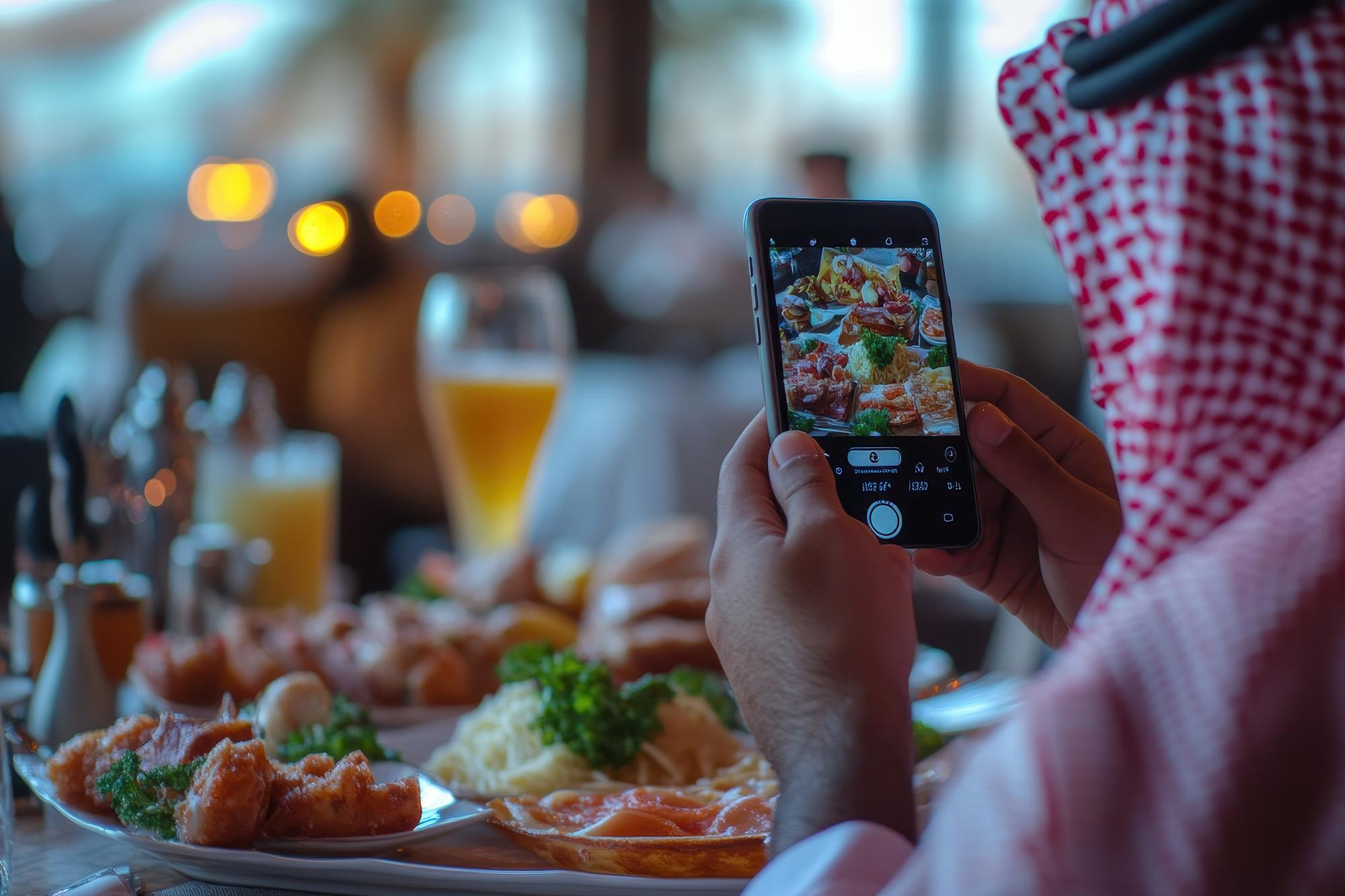
The New Face of TikTok Restaurant Marketing in the UAE
A diner sits in a taxi crossing Sheikh Zayed Road, thumb moving through a feed with no particular purpose. Somewhere between a cooking hack and a friend’s holiday clip, a fifteen-second video appears: a knife cutting through a slow-melting kunafa, steam rising off a plate of machboos, a barista finishing a saffron latte with a flourish. There is no caption urging a visit. No paid placement badge. Just a small, unglamorous cafe in Al Quoz that nobody in this diner’s circle had ever mentioned. Twenty minutes later, that diner is standing outside the same cafe, phone out, waiting for a table.
This is not a hypothetical. It is happening across Dubai, Abu Dhabi, and Sharjah with growing regularity, and it points to something restaurant owners and marketers can no longer treat as a side experiment. For years, the assumption in the region’s food and beverage industry was simple: build a beautiful Instagram feed, get a few influencers through the door, and the bookings will follow. That assumption still holds some truth, but it is no longer the whole story. TikTok restaurant marketing UAE conversations have moved from the margins of marketing meetings to the center of them, and the reason is not novelty. It is results.
The shift is easy to underestimate from the outside, because it looks, on the surface, like just another social platform gaining ground. What is actually happening is more structural. TikTok’s underlying mechanics reward a different kind of content than the platforms that came before it, which means restaurants that succeed there are not necessarily the ones with the biggest budgets or the most polished visual identity. They are the ones willing to show up honestly and consistently, and that changes the competitive landscape for independent restaurants in a way that is worth taking seriously.
This article looks at why TikTok has evolved from an entertainment app into a genuine discovery engine for UAE diners, how it differs from Instagram in practice rather than theory, and what restaurants across the country are actually doing to turn short-form video into full tables. It also looks honestly at where TikTok fits alongside the platforms that came before it, rather than pretending it has replaced them outright.
From Search to Scroll: How Restaurant Discovery Has Evolved?
A decade ago, restaurant discovery in the UAE followed a fairly predictable path. A person searched Google, checked a handful of reviews, glanced at a menu, and made a decision. That behavior has not disappeared, but it now shares space with something far more passive: algorithmic discovery, where the platform surfaces a restaurant before the diner has even thought to look for one.
Google and Instagram both still play enormous roles in how UAE residents choose where to eat, and neither is going anywhere. But the behavior sitting alongside them has changed. Where search is active, a person types a query because they already have intent, TikTok’s For You Page is passive. It does not wait for a query. It offers up content based on what a person has lingered on before, and food content, being visually irresistible almost by design, tends to perform exceptionally well within that system.
Why This Shift Matters for UAE Restaurants?
The practical consequence is that a restaurant no longer needs a diner to be actively hungry or actively searching in order to be discovered. It only needs one video to land in front of the right eyes at the right moment. That is a fundamentally different marketing proposition than optimizing a Google Business listing or hoping a hashtag gets noticed, and it rewards restaurants that understand how to create content built for a feed that rewards engagement, not follower count.
This is particularly significant in a market as densely packed with dining options as the UAE. With thousands of F&B outlets competing for attention across just a handful of major cities, standing out through search alone has become genuinely difficult. Passive, algorithm-driven discovery gives smaller and newer restaurants a route to visibility that does not depend entirely on how well they rank against far larger, better-funded competitors on a search results page.
Why TikTok Is Becoming a Discovery Engine, Not Just a Social App?
Calling TikTok a “discovery engine” rather than a social platform is not just marketing language. It reflects a genuine change in how people, particularly younger diners, are using the app.
The Follower-Count-Free Algorithm
Most social platforms reward accounts that already have an audience. Post to ten thousand followers, and a percentage of them will see it. Post to zero followers, and very few people will. TikTok does not work this way. Its distribution model is built around engagement signals rather than existing reach, which means a brand-new restaurant account with no history whatsoever can post a single video and have it seen by tens of thousands of people within a day, purely because the content held attention.
This matters enormously for smaller, independent restaurants in the UAE that cannot compete with the marketing budgets of larger chains. A home-grown cafe in Satwa with a great story and a willingness to film honestly has a genuinely fair shot at reaching the same size audience as an established brand, something that was far harder to achieve on Instagram’s more follower-weighted system.
It also changes how quickly a restaurant’s reputation can shift. A single strong video can introduce a two-month-old cafe to tens of thousands of potential diners overnight, compressing a growth timeline that might once have taken years of steady word-of-mouth and press coverage. That speed cuts both ways, of course; a lukewarm or awkward video can just as easily fall flat, which is part of why consistency, rather than chasing one viral hit, tends to separate restaurants with lasting momentum from those with a single lucky moment.
TikTok as a Search Engine for Younger Diners
A second, quieter shift is worth noting: a growing share of younger diners are typing queries directly into TikTok’s search bar instead of Google’s. “Best shawarma Dubai” or “hidden gem cafes Abu Dhabi” increasingly returns video results filmed by real diners, not polished business listings. For a generation raised on video-first platforms, watching someone eat a dish and react to it feels more trustworthy than reading a star rating.
This behavior is not confined to residents alone. Tourists arriving in Dubai and Abu Dhabi increasingly research their dining plans on TikTok before they even land, building a shortlist of places to visit based on video content rather than a traditional travel guide. A restaurant that ranks well in this kind of informal, video-based search stands to capture a meaningful share of visitor spending before a guest has even checked into their hotel.
A few patterns worth noting for any restaurant thinking about this shift:
- Search behavior is changing. Younger UAE residents increasingly treat TikTok’s search bar as a first stop for food recommendations, not a Google Maps query.
- Engagement outweighs polish. Videos that feel spontaneous and honest routinely outperform heavily produced content, even from brands with far larger budgets.
- Reach is not tied to history. A restaurant’s first video can outperform its hundredth, because the algorithm evaluates each piece of content largely on its own merit.
TikTok vs Instagram: What Actually Works Differently for Restaurants?
None of this means Instagram has lost its relevance. It means the two platforms now serve genuinely different functions in a diner’s decision-making process, and restaurants that treat them identically tend to underperform on both.
Content Style: Polished vs Authentic
The Instagram-first approach that many UAE restaurants adopted over the past several years leaned heavily on considered design: carefully lit interiors, styled plating, a consistent visual identity across every post. That approach still works well on Instagram, where the feed rewards a curated, cohesive aesthetic.
TikTok rewards the opposite instinct. A shaky, handheld clip of a chef plating during a busy Friday dinner service will often outperform a beautifully lit, tripod-mounted shot of the same dish. This is not a matter of production quality being unimportant; it is a matter of the platform’s culture actively favoring content that feels unscripted. Viewers on TikTok are quick to scroll past anything that reads as an advertisement, and quick to stay on anything that reads as a genuine moment.
Reach and Engagement Differences
The engagement mechanics also differ meaningfully. Instagram engagement tends to concentrate around an existing follower base, meaning growth is often slower and more linear. TikTok engagement is far more volatile, capable of sitting flat for weeks and then spiking overnight when a single video resonates. For a restaurant owner, this means TikTok requires a different kind of patience: consistent posting without an expectation of steady, predictable growth, and a willingness to treat each video as its own opportunity rather than a continuation of the last one.
How UAE Restaurants Are Actually Winning on TikTok?
Theory aside, a clear pattern has emerged among the UAE restaurants that have genuinely benefited from short-form video, and it has less to do with luck than most people assume.
Behind-the-Scenes and Kitchen Authenticity
The single most consistent driver of restaurant content performance on TikTok is authenticity. Footage of a busy kitchen mid-service, a head chef explaining why a particular spice blend matters, or front-of-house staff having a genuine laugh during a slow afternoon tends to build a level of trust that polished advertising rarely manages. The broader case for video as a branding tool supports this pattern well beyond the F&B sector: viewers consistently respond more strongly to content that feels human than to content that feels produced.
This does not mean quality is irrelevant. It means the kind of quality that matters has shifted. A shaky but genuine thirty-second clip of a chef tasting a sauce mid-service and reacting honestly tends to earn more watch time than a stiffly scripted promotional video, even one shot with professional equipment. Restaurants that understand this distinction tend to stop worrying about production value early on, and instead focus their energy on capturing moments that were going to happen anyway.
Localized Trend Participation
Global TikTok trends move fast, and restaurants that adapt them with a clear UAE flavor tend to perform better than those copying a trend wholesale. A viral sauce-pour format reworked around a regional dish, or a trending sound paired with footage of a Ramadan iftar spread, signals to viewers that the account understands both the platform and the local context it operates in. The growing role of video content across the region’s F&B industry reflects exactly this kind of localized creativity, where restaurants are not simply importing global formats but shaping them around Emirati and broader Gulf dining culture.
Dish Reveals and Menu Moments
Few things perform as consistently on TikTok as a well-shot dish reveal. A cheese pull, a slow sauce drizzle, the first bite reaction to something spicy or unusual. These clips tap into a genuine curiosity that goes beyond marketing; they answer a question a huge number of people are quietly asking themselves, which is simply what to eat next. That curiosity connects directly to the kind of content readers already search for, echoing the interest behind lists like dishes that keep showing up on Dubai diners’ must-try lists, where a handful of iconic dishes consistently draw attention regardless of the platform they are discovered on.
Micro and Nano-Influencer Collaborations
Perhaps counterintuitively, some of the strongest results come not from large influencers with sweeping follower counts, but from smaller, niche creators whose audiences trust their taste implicitly. A food creator with fifteen thousand highly engaged followers in Dubai will often drive more actual foot traffic than a creator with half a million followers spread across a dozen countries, simply because the smaller audience is local, relevant, and paying closer attention.
The most effective collaborations tend to avoid feeling like paid placements at all. Restaurants that give a creator genuine creative freedom, rather than a script to follow, usually end up with content that performs better precisely because it does not read as sponsored. A short, honest review from a trusted local creator, even a lightly critical one, often does more for long-term credibility than a glowing but obviously scripted endorsement.
A few content formats worth testing for restaurants new to the platform:
- POV-style clips: filmed from the diner’s perspective, walking through the ordering and eating experience as it happens.
- ASMR food shots: close, sound-focused footage of sizzling, pouring, or crunching that plays well even with the volume down.
- Staff-led trend videos: genuine, low-pressure participation in a trending format, filmed by the people who actually work the floor or the kitchen.
- Reaction clips: honest first-bite reactions, particularly to spicy, unusual, or visually dramatic dishes.
Building a TikTok Strategy That Actually Drives Restaurant Growth
Posting occasionally and hoping for a viral moment is not a strategy; it is a lottery ticket. Restaurants that see sustained results tend to approach TikTok with the same intentionality they would bring to any other core part of the business.
Content Pillars Worth Focusing On
A workable approach usually rests on three content pillars, used in rotation rather than randomly: educational content (how a dish is made, why an ingredient matters), entertainment (trend participation, humor, staff personality), and behind-the-scenes footage that builds familiarity over time. TikTok branding strategies built specifically for the UAE market consistently point to this same mix as the foundation for accounts that grow steadily rather than spiking once and disappearing.
Consistency and Algorithm Signals
Posting frequency matters more than most restaurant owners expect. Three to five videos a week is a reasonable starting cadence, not because the algorithm punishes gaps outright, but because consistent posting gives it more opportunities to learn what resonates with a given audience. A single excellent video posted once a month rarely builds the same momentum as a steady stream of good, honest content posted regularly.
TikTok Shop and In-App Discovery-to-Action Features
The platform’s growing commerce features are worth watching closely. As TikTok Shop and similar in-app ordering integrations expand across the region, the gap between seeing a dish and being able to act on that interest is shrinking fast. Restaurants that build an engaged following now are positioning themselves to benefit disproportionately once these features mature locally.
There is a real first-mover advantage available here. Restaurants that treat their TikTok presence as a long-term audience-building exercise, rather than a short campaign tied to a launch or a promotion, will be far better positioned to make use of these commerce tools the moment they become widely available in the UAE. Waiting until every competitor has already built an audience tends to be a far more expensive way to catch up later.
A short list of practical starting points:
- Film with a phone, not a production crew. Good lighting and a steady hand matter far more than expensive equipment.
- Hook viewers in the first two seconds. Attention drops fast; the opening frame needs to earn the rest of the watch time.
- Add captions to every video. A large share of viewers scroll with sound off.
- Post at consistent times. Predictability helps both the algorithm and a growing audience know when to expect new content.
Common Mistakes UAE Restaurants Make on TikTok
Not every restaurant that tries TikTok sees results, and the reasons are usually avoidable.
- Treating it like Instagram. Cross-posting a polished Reel with minimal changes rarely performs well; the platforms reward different instincts.
- Ignoring trending formats entirely. A total absence of trend participation can make an account feel disconnected from the platform’s culture.
- Inconsistent posting. Long gaps between videos make it difficult for the algorithm, and the audience, to build any momentum.
- Over-promoting without personality. A feed made up entirely of “book now” messaging tends to lose viewers quickly; entertainment and information need to come first.
For restaurants without the internal bandwidth to manage this consistently, professional social media marketing support can help maintain the pace and quality that the platform rewards, without pulling kitchen or floor staff away from their actual jobs.
Why a Multi-Platform Discovery Strategy Still Matters?
None of this suggests restaurants should abandon Instagram, Google, or any other channel in favor of TikTok alone. What has changed is the role each platform plays. Google remains the tool people reach for when they already have intent. Instagram continues to function as a visual portfolio and a place for more considered storytelling. TikTok has added a new, earlier layer to that journey, one where discovery happens before intent even forms.
The practical implication is that a restaurant’s digital presence now needs to work as a connected system rather than a set of separate channels. A diner who discovers a restaurant through a TikTok video will often check Instagram next to confirm the vibe, then search Google to check hours and reviews before finally deciding to book. Turning that attention into an actual reservation still depends heavily on how frictionless that final step is, regardless of which platform sparked the original interest.
Restaurants that treat these platforms as competing for the same budget and attention, rather than working together along a single journey, tend to underinvest in whichever one feels less immediately measurable. A more useful mental model is to think of TikTok as the spark, Instagram as the confirmation, and Google or a direct booking tool as the final step that turns curiosity into a seated guest. Weakening any one link in that chain tends to blunt the value of the others.
TikTok sparks the interest, Instagram confirms the vibe, and a frictionless booking step turns that curiosity into a seated guest.
What This Discovery Shift Means for Restaurant Business Growth?
It would be easy to treat all of this as a marketing curiosity rather than a business consideration, but the numbers suggest otherwise. The UAE’s fast-growing restaurant market is one of the most competitive in the world on a per-capita basis, with new concepts opening constantly across Dubai, Abu Dhabi, and Sharjah. In a market this saturated, visibility is not a nice-to-have; it is often the difference between a restaurant that fills its tables and one that quietly struggles despite genuinely good food.
Short-form video has effectively lowered the cost of visibility for restaurants willing to invest time rather than large budgets. A well-executed TikTok presence does not guarantee survival in a competitive market, but it removes one of the biggest barriers smaller and newer restaurants have historically faced: the inability to compete with established brands on marketing spend alone.
This matters just as much for established restaurants as it does for new entrants. In a market where diners are constantly exposed to new openings and shifting trends, staying visible is an ongoing effort rather than a one-time achievement. Restaurants that built strong brand recognition years ago cannot assume that recognition will carry them indefinitely; the diners discovering restaurants today are doing so through an entirely different set of habits than the ones who built that original reputation.
Practical Next Steps for Restaurants Getting Started on TikTok
For restaurant owners weighing whether to invest real time into this platform, a few grounded next steps tend to work better than diving in without direction.
- Start with a content audit. Look honestly at what is already being filmed on phones by staff and customers; there is often more usable footage than expected.
- Commit to a realistic posting schedule. Three videos a week, sustained for two to three months, tells a far clearer story than a burst of activity followed by silence.
- Study what already works locally. A week spent watching how other UAE restaurants use the platform reveals patterns worth adapting rather than copying outright.
Is TikTok Really the New Discovery Engine?
The honest answer sits somewhere between the two extremes. TikTok has not replaced Google’s role for diners who already know what they want, and it has not replaced Instagram’s role as a visual anchor for a restaurant’s identity. What it has done is insert itself earlier into the journey, reaching diners before they have even started actively looking, and doing so in a way that rewards authenticity over budget.
For UAE restaurants, that shift represents a genuine opportunity rather than a passing trend. The market is crowded, diners are increasingly discovering meals through a scroll rather than a search, and the restaurants paying attention to that shift now are the ones most likely to be found by the next diner scrolling through their feed on Sheikh Zayed Road, looking for nothing in particular and finding exactly what they did not know they were craving.
